3I/ATLAS’s Closest Approach to TERLINGUA GHOSTOWN RV PARK — A Rare Interstellar Visitor Lights Up the Sky (December 19, 2025)
Keywords: 3I/ATLAS closest approach, interstellar comet, 3I/ATLAS telescope viewing, how to see 3I/ATLAS, comet 3I/ATLAS Earth flyby, astronomy event December 2025
For early-morning skywatchers on Friday, December 19, 2025, a truly cosmic event is unfolding: the interstellar comet 3I/ATLAS will make its closest flyby of Earth — and although it won’t be visible to the naked eye, it’s a must-observe target for backyard astronomers and astrophotographers. Space+1
What Is 3I/ATLAS?
Originally discovered on July 1, 2025, by the ATLAS (Asteroid Terrestrial-impact Last Alert System) survey telescope in Chile, 3I/ATLAS (also known as C/2025 N1) is a rare interstellar comet — meaning it originated outside our solar system. NASA Science+1
Unlike typical comets that orbit the Sun on closed paths, 3I/ATLAS follows a hyperbolic trajectory, indicating it came from deep space and is now passing through the solar system just once before heading back into the galaxy. This makes it only the third known interstellar object ever detected, following ’Oumuamua in 2017 and 2I/Borisov in 2019. NASA Science
When sunlight heats the comet’s icy nucleus, it releases gas and dust, creating a glowing coma and faint tail — classic features of an active comet. Wikipedia
December 19, 2025: Closest Earth Flyby
At approximately 1 a.m. EST (06:00 GMT) on December 19, 3I/ATLAS will pass within about 1.8 astronomical units of Earth — roughly 170 million miles (270 million km) away. That’s close in cosmic terms, but still safely distant and far too faint for unaided eyes. Space+1
Although the comet isn’t threatening — and it won’t become bright enough to rival stars — its interstellar origin makes this event an extraordinary chance to collect data and observe an object that formed around another star. European Space Agency
How & Where to See 3I/ATLAS (Telescope Tips)
While 3I/ATLAS will be too dim to see without optical aid, amateur astronomers can still track it with the right setup:
1. Choose the Right Gear
- A telescope with an aperture of 150 mm (6″) or larger is ideal for spotting the comet’s faint smudge in the early morning sky. New York Post
- Binoculars may not suffice, but large binocular systems paired with star charts could help experienced observers try tracking its motion. Smithsonian Magazine
2. Look Before Dawn
- The best viewing window is pre-dawn, about 1–2 hours before sunrise.
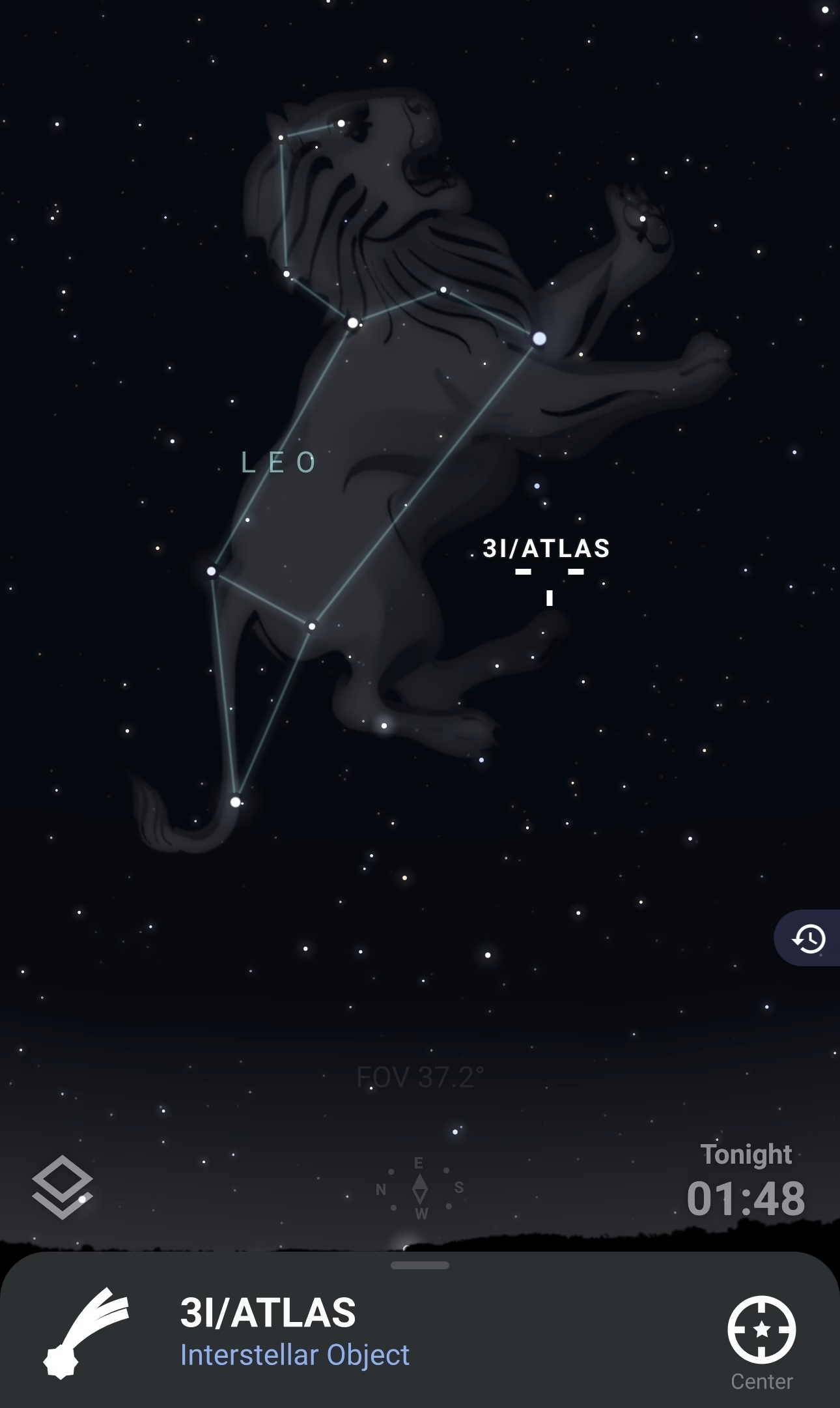
- Start by pointing your telescope to the eastern to northeastern sky, below the Leo constellation’s star Regulus, where the comet will appear as a faint fuzz. New York Post
3. Use Star Maps & Apps
- Sky mapping tools like Stellarium or SkySafari can help you pinpoint the comet’s location relative to known stars.
- Update your charts for December 19, 2025, since 3I/ATLAS’s motion changes night to night.
4. Photography Tips
- Long-exposure astrophotography with a tracking mount will yield the best results.
- Use high ISO and long shutter speeds to capture the comet’s faint coma and subtle motion against the background stars.
Can You Watch It Online?
Yes! If your local weather doesn’t cooperate or your telescope isn’t powerful enough, there are live streams and online coverage available. Projects like the Virtual Telescope Project often host free livestreams of 3I/ATLAS around its closest approach. Space
Livestream times vary with time zone, but many begin late on December 18 or early December 19 — check live telescope feed schedules for exact start times.
Why This Matters: Science & Space Exploration
3I/ATLAS isn’t just a visitor; it’s a scientific treasure.
Studying interstellar comets helps astronomers:
- Understand the composition of distant star systems.
- Compare chemical signatures against solar system comets.
- Test models of how comets evolve after leaving their birth systems. European Space Agency
Each interstellar object gives researchers a rare glimpse into materials and conditions that shaped planets and ice giants far beyond our own neighborhood.
Final Thoughts: A Celestial Christmas Treat
Don’t miss this once-in-a-lifetime cosmic encounter — 3I/ATLAS’s closest approach won’t repeat. Whether you’re a seasoned astrophotographer or a beginner with a telescope, this weekend offers a perfect opportunity to connect with the broader galaxy and witness an alien visitor streak through our skies.
Set your alarms for December 19, 2025, point those telescopes eastward before dawn, and get ready to observe one of the universe’s most fascinating travelers.
As you plan your next night-sky adventure, make Ghost town Rentals/RV Park and Big Bend After Dark your go-to resources for unforgettable dark-sky tourism in the Big Bend region. From comfortable RV stays and lodging at the doorstep of some of the darkest skies in North America to expertly guided stargazing experiences, celestial event tours, and hands-on astronomy and astrophotography adventures, everything is designed to help you experience the night sky at its best. Whether you’re chasing rare events like interstellar visitors, meteor showers, eclipses, or simply want to reconnect with the Milky Way, TGTRV.com and BigBendAfterDark.com are your trusted home base for next adventure.